
It starts with a single overhanging branch and often ends in a confusing neighbourhood dispute. While trees are majestic additions to any Tauranga property, they can quickly become a source of stress when they grow in the wrong place and encroach on a neighbour’s yard.
When a tree becomes a nuisance, the big question is always: Who is legally and financially responsible? You might deal with a leaning trunk or a fallen giant after a storm. In either case, understanding your duties protects your property and your wallet. In this guide, we break down the rules of tree removal to help you handle these situations with confidence.
What You Need to Know
Familiarising yourself with local rules helps you address tree issues before they escalate into costly disputes. In New Zealand, ownership depends on where the trunk meets the soil, dictating who must pay for upkeep or removal. As we move through 2026, climate patterns in Tauranga, NZ, make regular checks even more important for every property owner.
The law looks at the location of the tree to decide your duties. You should know these details to protect your property and your rights:
- Trunk Location Defines Responsibility. If the base of the tree sits entirely on your side of the fence, you own it. You are the person who must pay for any work needed to keep it safe.
- The Risk of Shared Boundaries. Sometimes, a tree grows directly on the property line. In these cases, you and your neighbour share the ownership and the costs for its care.
- Local Council Protections. Many areas have protected species or historic trees. Always check with the council before you start a large felling project to avoid heavy fines.
- The Cost of Neglect. You might be liable if a tree you knew of falls and hits a house. Regular inspections by a professional show that you are a responsible owner.
Trees-Community Law
The Community Law Manual outlines the legal framework for trees in New Zealand, which is set out in the Property Law Act 2007. The law balances your right to grow plants with your neighbour’s right to enjoy their property. If a tree causes a nuisance, you have several ways to resolve the issue.
The legal system provides ways to solve disputes when people cannot agree.These points explain what you can do on your side of the fence:
- The Right to Trim. You can cut any branches or roots that cross the boundary onto your land. This rule allows you to keep your property clear without needing to ask for permission first.
- Returning Property. Any wood or fruit you cut from a neighbour’s tree still belongs to them. You should return these items to the owner in a tidy manner.
- Section 333 Court Orders. You can apply to the District Court for an order to remove or trim a tree. The court may act if a tree obstructs your view or poses a risk to life.
- Liability for Damage. The owner of a tree is usually not liable for damage if the tree was healthy. However, they may have to pay if they knew the tree was dangerous and did nothing about it.
- District Plan Restrictions. The Resource Management Act 1991 allows councils to protect certain trees. You must obtain a permit to work on a tree with heritage or environmental value.
Trees and Power Lines
While the Property Law Act manages disputes between neighbours, separate regulations control trees near the electricity network. Trees that grow near power lines pose a high risk to the community and require different safety standards. In New Zealand, the Electricity (Hazards from Trees) Regulations 2003 set out the rules for these high-stakes situations.
New updates introduced stricter zones for tree growth. To stay safe and legal, you should familiarise yourself with the following regulations:
- Growth Limit Zones. These are the specific areas where no part of a tree should ever enter. The required distance depends on the voltage of the lines in your street.
- The First Cut. Your local network company often pays for the first trimming of trees near power lines. After this first cut, the landowner becomes responsible for the cost of future work.
- Notice Zones. You might receive a hazard warning if your tree grows too close to a line. You must act within the time limit set out in the notice to avoid a fine.
- Penalties for Neglect. Failure to comply with a cut notice can lead to large fines. You could also be liable for the cost of repairs if your tree damages the power grid.
- Certified Workers. You cannot trim trees within four metres of power lines yourself. You must hire an arborist with a specific certification to work safely near live wires.
Managing a Fallen Tree
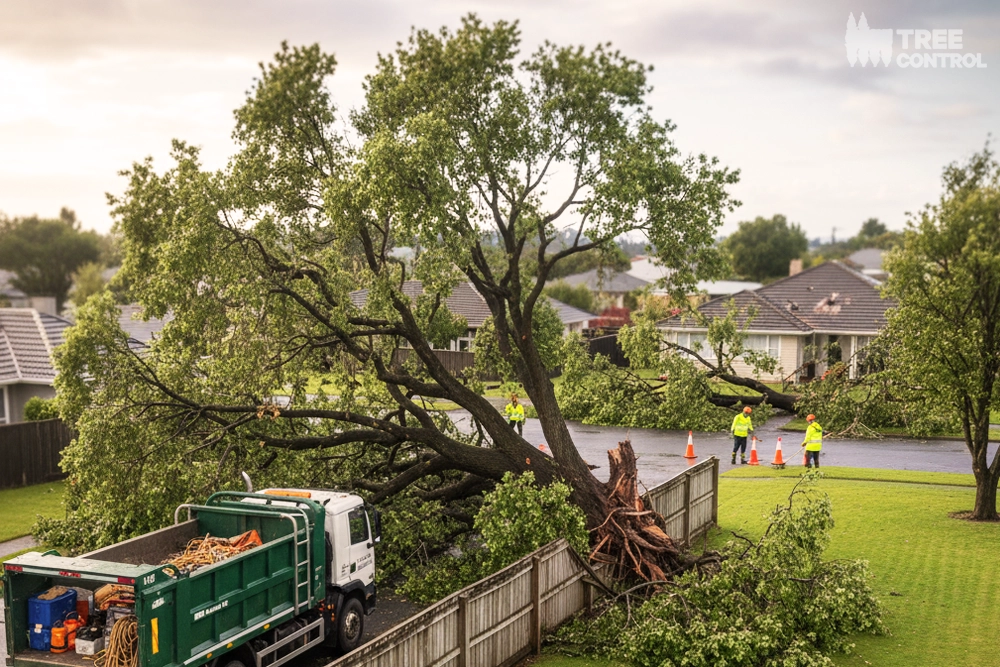
A fallen tree creates an immediate need for action. The responsibility for removal depends on why the tree fell and where it landed. Most people find that a clear plan helps them handle the aftermath of a storm quickly.
- The Source Property. The owner of the land where the tree stood is usually responsible for its removal. Therefore, you should call a professional to safely clear the debris.
- Healthy Trees and Storms. A healthy tree that falls during a storm is seen as a natural event. In these cases, you and your neighbour will probably pay for the cleanup on your own sides of the fence.
- Sick or Neglected Trees. You are likely liable if you knew your tree was unstable. If a dead tree falls onto a neighbour’s house, you may have to pay for all the damage.
- Removing Obstructions. You must clear any part of your tree that blocks a public road or footpath. The council can do this work and send you the bill if you do not act.
- Insurance and Removal. Most home policies cover the cost to remove a tree if it hits a building. They might not pay for the removal if the tree simply falls onto a lawn without causing damage.
What You Need To Do
You should follow a clear process when you decide to manage your trees. Taking the right steps helps you stay within the law and keeps your property safe. These actions help you handle tree care with confidence in 2026.
Proper planning makes tree removal much easier for everyone involved. You should use these steps to keep your project on track:
- Talk To Your Neighbour Early. Many people solve problems with a simple conversation. You should tell the person next door about your plans before you pick up any tools.
- Check The District Plan. The Tauranga City Council has rules about certain types of wood. You must confirm if your tree has a protection order before you start any felling.
- Hire A Professional Arborist. A trained expert can spot signs of decay that you might miss. Their report provides proof that you fulfilled your duties as an owner.
- Create A Written Agreement. You should write down what you and your neighbour decide. This document should show who will do the work and how you will pay for it.
- Handle The Wood Correctly. You have the right to trim branches back to the boundary line. You must offer the wood back to the owner because it belongs to them.
- Contact Your Insurance Provider. You should ask about your coverage for fallen trees. This helps you understand your financial risk if a storm damages a fence.
- Avoid Entering Other Land. You do not have the right to go onto a neighbour’s property without their consent. You must ask for permission if you need to step over the fence.
Partner with Tauranga’s Tree Care Experts
A fallen tree creates a major hazard and disrupts your day. You have a duty to keep your trees healthy to protect your neighbours. If you ignore a sick tree, you could be liable for the damage it causes. As a solution, hiring an expert to inspect a weak tree helps you stay safe and responsible.
Strong storms can bring down even healthy plants. In these cases, you and your neighbour should cooperate to clear the mess. Keeping good records of your tree maintenance helps with insurance claims. This proof shows your provider that you managed your land with care.
At Tree Control, we bring years of experience to every felling and pruning project in the Bay of Plenty. Our team uses specialist machinery to handle even the most difficult removals safely. If you have questions about a tree’s health, please get in touch with us. We also provide guidance on who is responsible for tree removal, along with a full range of tree care and removal services.
Frequently Asked Questions
Can I charge my neighbour for trimming their overhanging branches?
Generally, no. Under NZ law, you have the right to trim branches encroaching on your property to the boundary line (abatement), but you usually must bear the cost yourself. You cannot bill your neighbour for this work unless you have a prior written agreement or a court order stating the tree is a nuisance or danger.
Do I need council permission to remove a tree on my own land?
It depends on the tree. While you own trees on your land, Tauranga City Council protects specific “Notable Trees” and trees in certain ecological zones. Before felling, always check the District Plan or request a Land Information Memorandum (LIM) to ensure the tree isn’t protected. Removing a protected tree without resource consent can result in significant fines.
What acts as proof of “negligence” if a neighbour’s tree damages my home?
To prove negligence, you must demonstrate that the owner knew or should have known the tree was dangerous before it fell. Strong evidence includes:
- Previous written correspondence (emails or letters) warning them of the danger.
- A past arborist’s report identifying rot, instability, or disease.
- Photos showing visible decay prior to the storm. Without this proof, insurers often treat the event as an “Act of God,” meaning you pay for your own repairs.
Who pays if a tree grows into power lines in Tauranga?
The first cut is usually free; subsequent cuts are your cost. Local network companies generally pay for the initial “first cut” to clear lines. After that, the property owner is legally required to maintain the “Growth Limit Zone.” If you ignore a specific cut notice (hazard warning) and the network company has to intervene, they can bill you for the work and any resulting line damage.
Can I throw the cut branches back over the neighbour’s fence?
Technically yes, but it is not recommended. Legally, the clippings belong to the tree owner, and you should offer them back. However, simply dumping them over the fence can be considered “rubbish dumping” or cause a new dispute. The best practice is to ask if they want the wood (e.g., for firewood). If they refuse, you generally have to dispose of the green waste yourself.
What is the “Section 333” court order mentioned in tree disputes?
A Section 333 order (under the Property Law Act 2007) is a legal ruling you can apply for if a neighbour’s tree is causing undue harm. The District Court can order the tree to be removed or trimmed if you can prove it causes actual damage, creates a risk to life, or creates an “undue obstruction” of your view or light. This is usually a last resort when friendly negotiation fails.