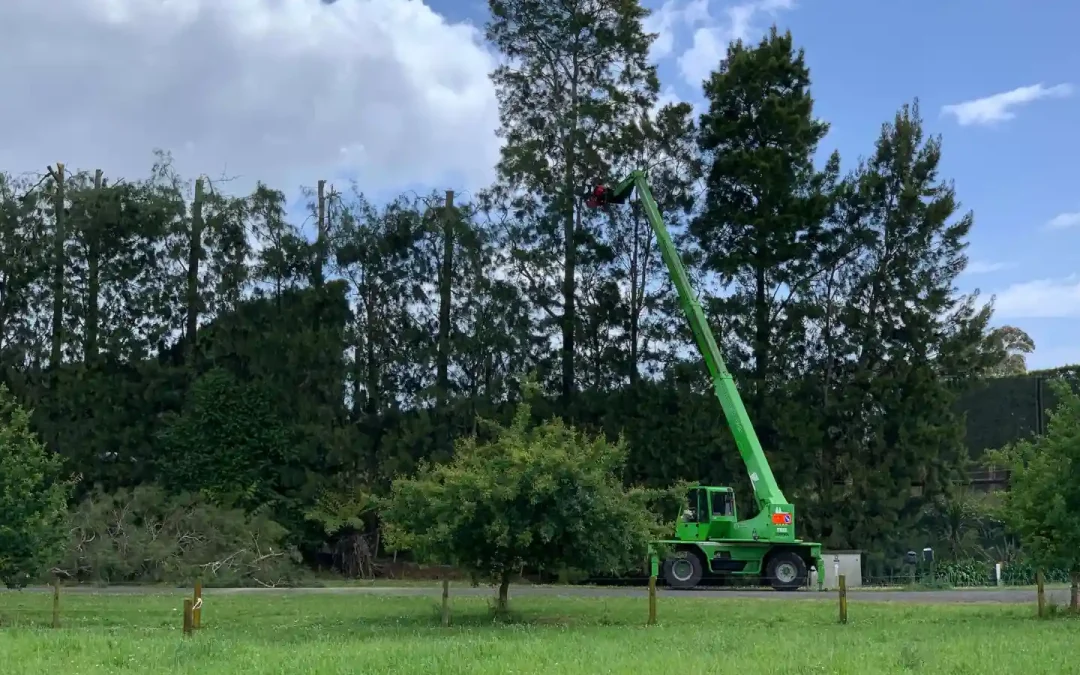
A failing tree over a car park, warehouse roof, or busy road isn’t a grounds maintenance job. It’s a liability sitting on your books. At Tree Control, our fleet of four customised machines handles these trees from inside the cab, so no one has to climb into a canopy that might not hold.
This commercial tree removal guide covers what Bay of Plenty and Waikato businesses need to sort before any work starts. You’ll find the warning signs to watch for, the council and power line rules, a site checklist, what drives cost, and how to pick the right team for the job.
When to Remove a Tree on Commercial Property (Before It Becomes a Liability)
Knowing when to remove a tree on a commercial property usually comes down to what’s underneath it. A tree over a loading bay or tenant car park carries far more risk than one on an empty boundary.
Signs worth acting on:
- A new or worsening lean, especially with soil lifting at the base
- Cracks, cavities, or fungal growth on the trunk or main limbs
- Roots lifting seal, kerbs, or foundations
- Dead limbs above walkways, parking, or entrances
But removal isn’t always the answer. A healthy tree that has outgrown its spot can often stay on with high tree topping, which reduces its height while keeping the shade, shelter, and habitat.
Start With a Tree Hazard Assessment for Businesses
A tree hazard assessment for businesses gives you a written record of the risk, not just an opinion. It should note what the tree could hit, any visible defects, how likely failure is, and the recommended action.
Under the Health and Safety at Work Act 2015, whoever runs the site must manage foreseeable risks to workers and the public, and an assessment shows you’ve done it.
Stay Compliant With Tree Removal Regulations for Businesses
Most delays on commercial jobs come from paperwork, not the tree. These are the tree removal regulations for businesses that we see catch people out.
Protected and notable trees
Tauranga’s City Plan lists notable trees and significant groups of trees, and work on a listed tree generally needs resource consent. Waipā and other Waikato councils keep their own registers, and removing a protected tree without consent can lead to a fine under the Resource Management Act.
Trees near power lines
The Electricity (Hazards from Trees) Regulations set minimum distances between trees and lines, and those distances increased in October 2024. Lines companies such as Powerco require any tree within 4 metres of their lines to be handled by an approved contractor.
Roadside trees
Work in the road corridor needs a Corridor Access Request (CAR) and an approved Traffic Management Plan (TMP). Councils won’t issue a Work Access Permit until the TMP is signed off.
Tree Removal Planning for Commercial Sites: Your Pre-Work Checklist
Good tree removal planning for commercial sites means the crew arrives to a ready site. Run through this commercial tree removal checklist before booking:
- Hazard assessment completed and filed
- District or city plan checked for protected trees
- Lines company contacted if the tree is near power lines
- CAR and TMP lodged for any roadside work
- Tenants, staff, and neighbours told about dates and access changes
- Machine access confirmed (gates, ground, and overhead clearance)
How a Controlled Commercial Tree Removal Process Keeps Your Site Running
Traditional removal usually puts a climber in the canopy, with rigging and a wide drop zone below. Our commercial tree removal process works differently:
- Site Assessment: We confirm the hazards, access, and what’s underneath.
- Permits and Set-Up: Consents, line clearances, and traffic management are sorted first.
- Controlled Removal: The operator works from inside the cab. A hydraulic saw cuts each section, and a grab holds it, separates it, and lowers it to the ground.
- Clean-Up: Green waste is dealt with, and the site is handed back.
Because each section is held rather than dropped, the work zone stays tight. Controlled tree removal jobs that might take days by climbing are often finished in hours.
Commercial Tree Removal Safety Guidelines That Protect Your People
These commercial tree removal safety guidelines sum up the best practices for commercial tree removal we follow on every job:
- Set and hold exclusion zones for staff, customers, and vehicles
- Keep people out of the tree wherever a machine can do the work
- Confirm line clearances with the network owner before starting
- Stop work if wind or ground conditions change
How Much Does Commercial Tree Removal Cost? What Actually Moves the Quote
How much commercial tree removal costs depends on the job, so a site visit beats a phone estimate. The main factors are:
- Tree height, size, and condition
- Distance to power lines, buildings, or roads
- Consents, line clearances, and traffic management
- Site access and ground conditions
- Job length, which also drives traffic management hours
How to Choose a Commercial Tree Removal Company You Won’t Need to Supervise
Working out how to choose a tree removal company comes down to asking the right questions before you sign off on a quote:
- What public liability cover do you carry?
- Are your staff qualified, and are you approved to work near power lines?
- Who handles the CAR, TMP, and lines company paperwork?
- What equipment will you bring, and will anyone need to climb?
A qualified commercial arborist should answer every one of these questions without hesitation.
Plan Early, Remove Once
Commercial tree work goes smoothly when the risk is assessed early, the rules are checked, and the site is ready before the crew arrives.
Tree Control works across Tauranga, the Bay of Plenty, and the Waikato region with four customised machines built for large, dangerous, and hard-to-reach trees. Our operators stay out of the canopy, and each section is lowered under control.
Got a tree that’s worrying you? Request a site assessment from our team today.
Frequently Asked Questions
Do I need council consent to remove a tree on commercial land?
Only if the tree is protected under the district or city plan. Check your council’s plan maps before work starts, as removing a listed tree without consent can mean a fine.
Who’s responsible for trees near power lines on my commercial property?
The tree owner is generally responsible for keeping trees clear of lines. Within 4 metres, the work must be done by a contractor approved by your lines company.
What happens to the timber and green waste?
Green waste can be mulched on site, taken away, or set aside for reuse. Mulch spread back onto gardens keeps organic material on your property.
Should we remove the tree or have it topped instead?
If the tree is healthy and height is the problem, topping can reduce the risk and keep the tree. If it’s structurally failing, removal is the safer call.
Can a roadside tree be removed without closing the road?
Often, yes. Because our machines hold and lower each section, many roadside jobs run with lane management rather than a full closure. You’ll still need an approved Traffic Management Plan.